

Is Your Aquarium Water Safe for Your Fish?
Last Updated: November 1, 2026
Quick Summary
Aquarium water quality determines whether your fish stay healthy, and most fish losses trace back to water that was never tested. Regular testing of pH, ammonia, nitrite, nitrate, hardness and temperature, logged over time, shows what is really happening in the tank.
- Test ammonia, nitrite and nitrate with a liquid reagent kit, the reference standard for hobbyists.
- Sample from the same spot each time and log readings so trends are visible.
- Test weekly in a new tank, then at least every two weeks once it is stable.
- Test your tap water first and choose fish that match it.
- If ammonia is detected, do a large partial water change, stop feeding for a day or two, and retest.
Table of Contents
- Why Aquarium Water Quality Matters for Fish Health
- Basic Aquarium Water Chemistry: The Parameters You Need to Know
- Aquarium Water Testing: Tools, Routines and Accuracy Limits
- Ammonia, Nitrite and Nitrate: Reading the Nitrogen Cycle
- Cloudy Aquarium Water: Causes and How to Clear It
- Species-Specific Ranges, Tap Water and Temperature
- Building Your Water Quality Routine and Next Steps at PatriotPetz
- Frequently Asked Questions
Why Aquarium Water Quality Matters for Fish Health
Aquarium water quality is the single biggest factor in whether your fish stay healthy, and most fish losses trace back to water that was never tested. Fish breathe, excrete and absorb everything they live in, so the water is effectively their blood, lungs and kidneys combined. A fish that looks fine one week can be showing clamped fins or lethargy the next, and the cause is often a water parameter nobody checked.
Think of your tank as a closed system. Every bit of waste, uneaten food and decaying plant matter feeds into it, and nothing leaves unless you remove it. Aquarium water quality is what determines whether that load stays manageable or builds to a level that stresses or harms the animals inside.
Watch out: Fish often hide illness until it is advanced. Waiting for visible symptoms before testing is the most common reason a tank crashes.
Basic Aquarium Water Chemistry: The Parameters You Need to Know
Several measurements tell you what is happening in the water. The core ones are pH, ammonia, nitrite, nitrate, general hardness (GH) and carbonate hardness (KH), plus temperature. Each one answers a different question, and they interact. A pH reading means little on its own if you do not know the water's buffering capacity, which is what KH measures.
Most tropical freshwater fish do best within a pH range of roughly 6.8 to 7.8, though some species need higher or lower levels. That range is a starting point, not a rule. Source your own tap water first, then match your fish to it rather than the reverse.
Aquarium Water Testing: Tools, Routines and Accuracy Limits
Testing is the only way to know what is actually happening in your tank, and the tool you choose determines how much you can trust the number. There are three main options, and each has real trade-offs.
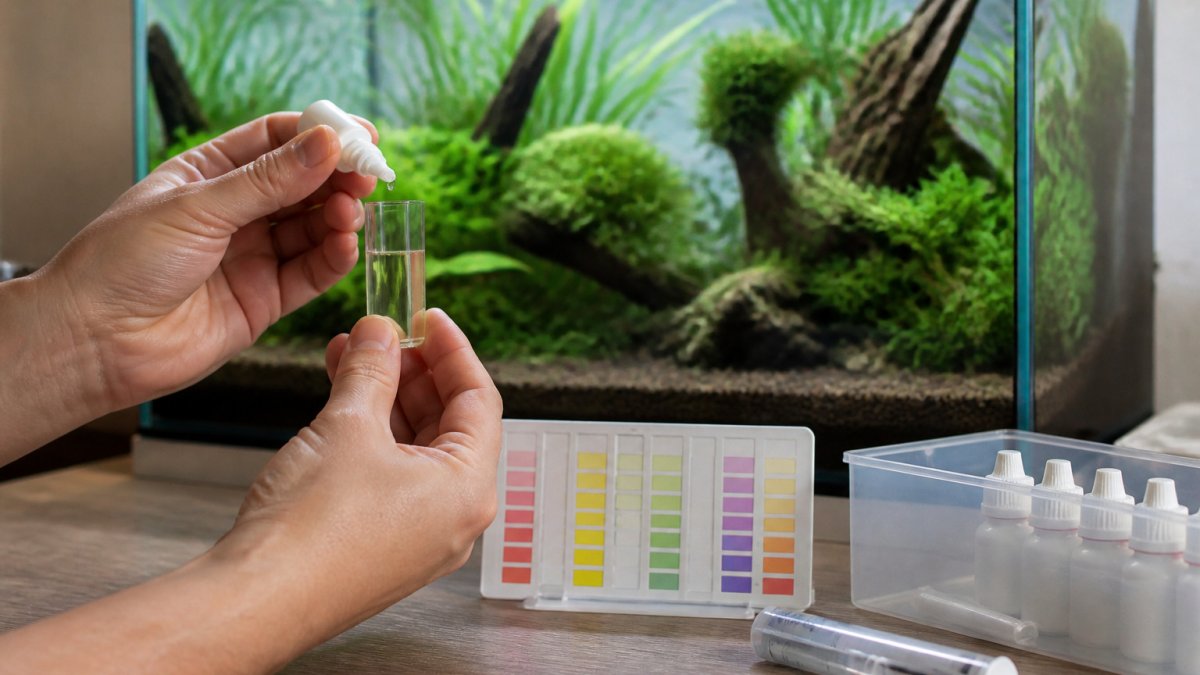
Liquid reagent kits mix a water sample with drops of reagent and compare the color against a chart. They are the reference standard for hobbyists: accurate enough to catch a low ammonia reading, and the reagents last for years if stored properly. The trade-off is time and cost per test. For ammonia, nitrite and nitrate, a liquid kit is the better investment.
Test strips are fast and convenient but read less precisely, and their color charts can be hard to match under some lighting. They are useful for quick pH and hardness checks, not for confirming a dangerous ammonia spike.
Digital meters (pH pens, conductivity/TDS meters) remove color-matching guesswork but require calibration against reference solutions and proper storage. An uncalibrated meter is worse than a strip because it looks authoritative while drifting.
How to Resolve Conflicting Readings
When two tests disagree, do not average them. Retest with a fresh sample from the same spot, check that reagents are in date and stored away from heat and humidity, and confirm you used the correct sample volume. If a liquid kit and a strip disagree on ammonia, trust the liquid kit and retest. If a digital meter and a liquid kit disagree on pH, recalibrate the meter before trusting either.
Sampling and Logging
Sample from the same location each time, mid-tank, away from the filter outflow and the substrate, so your readings are comparable week to week. Record pH, ammonia, nitrite, nitrate, GH, KH and temperature in a simple log. Trends matter more than any single number: a nitrate that climbs steadily between water changes tells you more than one isolated reading. Track readings over time instead of trusting any single result.
Testing Schedule
Test weekly during a new tank's first months, when the nitrogen cycle is still establishing, and then at least every two weeks once the tank is stable. Test immediately after any problem, a die-off, a filter failure, or a sudden change in fish behavior, and always retest after a corrective water change to confirm the fix worked.
The right test tool depends on what you need to confirm, and each option has trade-offs in accuracy, speed and cost.
| Tool | Best for | Key difference |
|---|---|---|
| Liquid reagent kit | Ammonia, nitrite, nitrate | Reference standard; accurate but slower and costlier per test |
| Test strips | Quick pH and hardness checks | Fast and convenient; less precise color reading |
| Digital meter | pH, conductivity/TDS | No color matching; must be calibrated or it drifts |
Ammonia, Nitrite and Nitrate: Reading the Nitrogen Cycle
Ammonia enters the tank from fish waste, uneaten food and decomposing matter. Beneficial bacteria convert it to nitrite, and a second group converts nitrite to nitrate. Nitrate is far less toxic and is removed through water changes and plant uptake. The whole sequence is the nitrogen cycle, and an established tank should show zero ammonia and zero nitrite with measurable nitrate.
Aquatic Turtle Monthly Box: Food, Filter and Water Care Bundle →
Ammonia and nitrite are toxic even at low concentrations, and nitrate is best kept as low as practical. Many keepers aim to keep nitrate well below the levels that stress fish, but the acceptable ceiling depends on species, so check the requirements for your own animals.
Ammonia in Fish Tank Water: Causes and Immediate Response
Ammonia spikes usually come from overfeeding, a dead fish or invertebrate, a filter that was cleaned too aggressively, or a new tank that has not finished cycling. If you detect ammonia, act the same day: perform a large partial water change using dechlorinated water matched to the tank's temperature, stop feeding for a day or two, and retest. Check that your filter is running and not clogged. Repeat testing until ammonia returns to zero.
Cloudy Aquarium Water: Causes and How to Clear It
Cloudy water is usually bacterial bloom, which appears in new tanks, or suspended particulate from substrate disturbance or overfeeding. A bacterial bloom is typically harmless to fish but signals an unfinished cycle or excess nutrients. Reduce feeding, avoid overcleaning, and confirm your filtration is adequate for the tank size. If the cloudiness persists alongside any ammonia or nitrite reading, treat the water quality problem first; clear water on its own does not mean the water is safe.
Species-Specific Ranges, Tap Water and Temperature
Parameter targets should follow the species, not a generic chart. Aqueon's guidance and Aquarium Science's ranges both show that requirements vary, so look up your specific fish before adjusting anything. A few practical examples make the point:
- Community tropical freshwater (tetras, rasboras, most livebearers): pH roughly 6.8-7.8, GH in the soft-to-moderate range, temperature around 75-80°F.
- Rift Lake cichlids (from Lake Malawi and Lake Tanganyika): pH in the high 7s to low 8s and hard, mineral-rich water, the opposite of what many community fish need.
- Discus and many South American species: softer, more acidic water and warmer temperatures, often in the low 80s°F.
- Saltwater and reef tanks: salinity measured with a refractometer, stable alkalinity, and tighter temperature control than most freshwater setups.
Planted tanks add another layer: plants consume nitrate and can shift pH and KH through the day, so a planted tank may run lower nitrate than a bare community tank with the same stocking.
Start With Your Source Water
Before you adjust anything, test your tap water. Many municipal supplies contain chlorine or chloramine that must be neutralized with a conditioner, and chloramine does not gas off the way chlorine does, so letting water sit out is not enough. Your tap's hardness and pH set your baseline; it is usually easier to choose fish that match your water than to fight your water chemistry every week. If your source water is very hard, very soft, or high in nitrate, reverse-osmosis water blended back with a remineralizer can give you a clean starting point, but RO water must be remineralized before use, because it has no buffering capacity or minerals of its own.
Temperature and Dissolved Oxygen
Keep temperature stable within the range your species needs. Warmer water holds less dissolved oxygen, which matters more as stocking density rises, so a heavily stocked or warm tank benefits from surface agitation, a filter outflow aimed at the surface, an air stone, or a powerhead. Gas exchange happens at the surface, so a lid that seals tightly or a still, low-flow tank can leave fish short of oxygen even when the chemistry looks fine. Watch for fish gulping at the surface as an early sign.
For reptiles and other semi-aquatic animals, the same water-quality principles apply, but the whole habitat matters too. Our beginner's guide to reptile habitat setup walks through how water, temperature and enclosure design work together.
Building Your Water Quality Routine and Next Steps at PatriotPetz
A good routine is simple: test on schedule, log the results, perform regular partial water changes, and keep filtration clean without sterilizing it. Water-change frequency and volume depend on species, tank size and stocking, so adjust based on your readings rather than a fixed rule.
If you are setting up or upgrading a tank, PatriotPetz can help with the basics. Our Aquatic Turtle Monthly Box: Food, Filter and Water Care Bundle at $52.99 includes filter cartridges and water conditioner for aquatic turtle keepers, and you are welcome to talk through your water setup with us in person.

Frequently Asked Questions
What water parameters should I test in an aquarium?
Test ammonia, nitrite, nitrate and pH at minimum. Ammonia and nitrite should read zero in an established tank, and nitrate is usually kept below about 40 ppm through regular water changes. Add general and carbonate hardness, temperature and dissolved oxygen as your species requires. Most tropical freshwater fish do best at a pH of roughly 6.8 to 7.8, but some species need higher or lower levels, so check the requirements for your specific fish before adjusting anything.
How often should I test aquarium water?
Test weekly while a new tank is cycling and whenever you add fish, change food habits or notice unusual behavior. Established tanks usually need testing every one to two weeks. Water-change frequency and volume vary with species, tank size and fish numbers, so use your test results rather than a fixed schedule to decide when to act.
How do I fix high ammonia in a fish tank?
Perform a large water change of 25 to 50 percent immediately, dechlorinate the replacement water, and stop feeding for a day or two. Check that your filter is running and has not been cleaned with tap water, which can kill beneficial bacteria. Retest daily until ammonia reads zero, then keep testing regularly to confirm the biological filter is recovering.
Why is my aquarium water cloudy?
Cloudy water usually comes from a bacterial bloom in a new tank, excess food or waste, or a filter that is not clearing debris. A white haze typically signals bacteria and often clears on its own within a few days if feeding is reduced. Green water points to algae from too much light. Address the cause first, then use mechanical filtration and partial water changes to clear the water.
Keeping water safe is ongoing work, but it is manageable once you know what to measure and when. Start testing this week, and call us at the store if a reading surprises you.
