

The Beginner's Guide to Reptile Habitat Setup
Last Updated: October 25, 2026
Quick Summary
A proper reptile habitat setup for beginners requires an appropriately sized enclosure for your species' adult size, a temperature gradient with thermostat control, UVB lighting on a 12-hour cycle, and the correct humidity level. Bearded dragons need 75-gallon tanks or larger, corn snakes do well in 40-gallon breeder tanks, and these foundational elements prevent the most common beginner mistakes.
- Bearded dragons rank at the top for beginners because they're docile, interactive, and forgiving of minor mistakes.
- Adult bearded dragons thrive in 75-gallon tanks or larger, while corn snakes do well in 40-gallon breeder tanks.
- A thermostat prevents overheating by cycling heat on and off to maintain target temperature, preventing lethal spikes.
- Replace your UVB bulb every six to twelve months regardless of whether it still lights up.
- Provide at least two hides per enclosure, one on the warm side and one on the cool side, to prevent chronic stress.
Table of Contents
- Choosing Your First Beginner Reptile Species
- Beginner Reptile Enclosure Size and Tank Selection
- Reptile Heating and Lighting Setup Essentials
- Humidity, Substrate, and Hides
- Reptile Habitat Supplies Checklist for First-Time Setup
- Reptile Enclosure Cleaning Schedule and Maintenance
- Testing Your Setup Before Bringing Home Your Reptile
- Getting Started With Your New Reptile Habitat
- Frequently Asked Questions
Choosing Your First Beginner Reptile Species
The best reptile habitat setup for beginners starts with picking the right animal. Not all reptiles have the same needs, and choosing a species that matches your lifestyle and space makes the entire process smoother.
Bearded dragons rank at the top for beginners. They're docile, interactive, and forgiving of minor mistakes. Corn snakes come in second, they're low-maintenance, don't require as much space as you'd think, and rarely bite.
The key difference between these species isn't personality, it's enclosure demands. A 40-50-gallon enclosure is often cited as a minimum starting point for common species such as bearded dragons. But that's just the baseline.
Pick based on the actual adult size of your species, not hatchling size. Many beginners buy a small enclosure thinking they'll upgrade later, then find themselves scrambling or keeping an undersized animal.
Beginner Reptile Enclosure Size and Tank Selection
Your reptile habitat setup hinges on choosing an enclosure that matches your species' adult size and behavior. Glass terrariums, melamine enclosures, and PVC vivarium setups each have trade-offs.
For most beginners, a 75-gallon glass terrarium works for bearded dragons, while a 40-gallon breeder tank suits corn snakes. The dimensions matter as much as volume, a tall, narrow tank isn't the same as a long, shallow one.
One contrarian point: bigger isn't always better if your heating can't reach all corners. An undersized enclosure with perfect temperature gradients beats an oversized one where half the space is too cold.
Tank placement affects everything. Avoid direct sunlight (it causes temperature spikes), drafty areas, and high-traffic zones where vibrations stress the animal. A stable shelf or stand in a quiet room works best.
Reptile Heating and Lighting Setup Essentials
Heat and light are the foundation of any reptile habitat setup. Without proper heating, your reptile can't digest food, regulate immunity, or reproduce. Without UVB light, calcium metabolism fails and bones weaken (pubmed.ncbi.nlm.nih.gov). These aren't optional, they're life-or-death requirements.
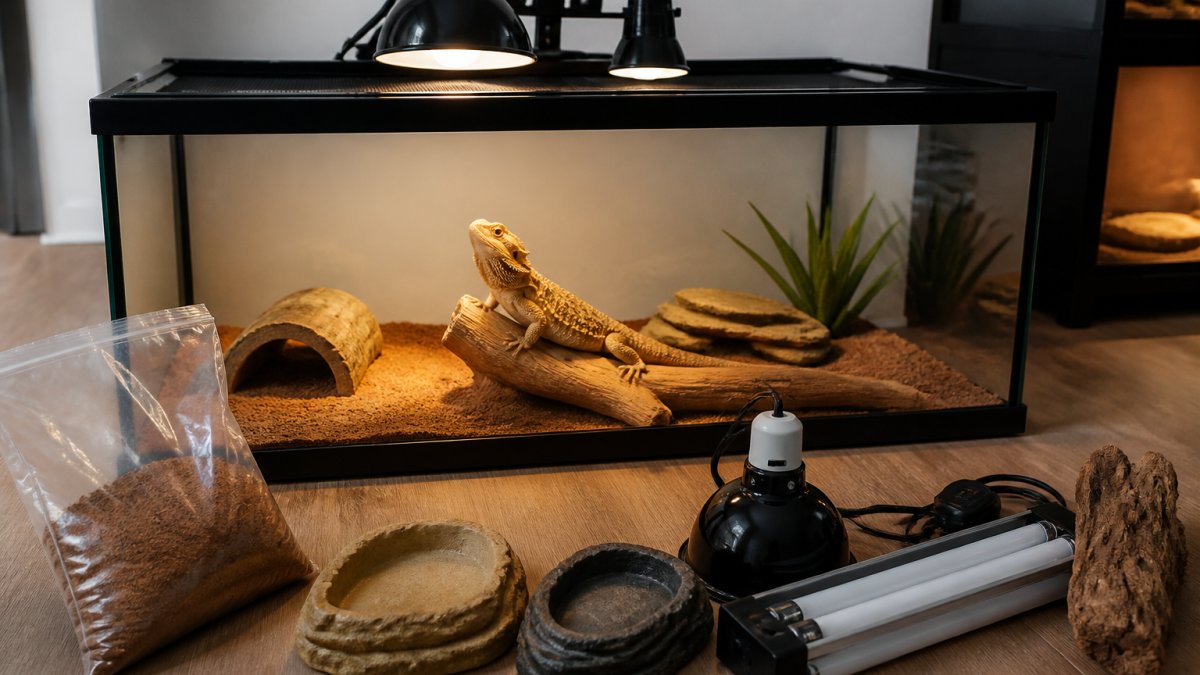
Temperature Gradient and Basking Areas
Desert reptiles like bearded dragons need a temperature gradient: a warm basking side (95-110°F) and a cooler side (75-85°F). This lets them thermoregulate, moving between zones to adjust their body temperature.
A basking bulb (typically 60W for small enclosures) mounted in a dome fixture above a rock, log, or tile provides the warm spot.
Aquatic and semi-aquatic species like turtles also need basking areas. A basking platform above the water, heated by a lamp, lets them dry off and absorb heat. Without it, they develop shell rot and respiratory infections.
Here's the part most guides miss: a thermostat prevents overheating. Plug your heat lamp into a thermostat, not directly into an outlet. The thermostat cycles the heat on and off to maintain your target temperature.
UVB Lighting and Day-Night Cycles
UVB light enables vitamin D3 synthesis, which allows calcium absorption. Without it, reptiles develop metabolic bone disease, soft, deformed bones that eventually cause paralysis and death. There's no workaround. Your reptile needs UVB.
Two types of UVB bulbs exist: fluorescent tubes (T5 or T8) and mercury vapor bulbs. T5 HO (high-output) tubes are the current standard, they're efficient, long-lasting, and provide consistent UVB output. Mercury vapor bulbs combine heat and UVB but are harder to control and overheat small enclosures.
UVB output degrades over time. The bulb may still glow, but UVB fades after 6-12 months of use. Replace your UVB bulb every six to twelve months regardless of whether it still lights up.
Day-night cycles matter too. A 12-hour light, 12-hour dark cycle mimics natural conditions and regulates your reptile's behavior and hormones. Use a timer so you don't have to remember to switch lights on and off.
The ReptiSun guidelines on UVB requirements vary by species, some desert species need more intense UVB than rainforest species. Check your specific animal's needs before buying bulbs.
Humidity, Substrate, and Hides
Humidity requirements split reptiles into two camps: desert species (bearded dragons, uromastyx) that thrive in 30-40% humidity, and tropical species (ball pythons, many lizards) that need 50-70%. Measure humidity with a hygrometer, guessing leads to respiratory infections or dehydration.
Desert species don't need special humidity management; their enclosure naturally stays dry. Tropical species need daily misting or a humid hide (a box filled with moist substrate where the animal can retreat).
Substrate, the floor material, serves multiple purposes: it maintains humidity, allows burrowing behavior, and aids digestion if accidentally ingested. Bearded dragons do well on tile or paper-based substrate that's easy to clean.
Hides are non-negotiable. A reptile without a hide experiences chronic stress. Provide at least two hides per enclosure: one on the warm side and one on the cool side.
Enrichment items like climbing branches, rocks, and plants encourage natural behavior. They also break up the visual space, making the enclosure feel larger.
Reptile Habitat Supplies Checklist for First-Time Setup
Before you bring your reptile home, gather these essentials:
Reptile Heat and UVB Lighting Kit: Dome Fixture and Bulb Bundle →
| Item | Purpose | Beginner Priority |
|---|---|---|
| Enclosure (appropriate size for species) | Primary habitat | Critical |
| Heat lamp and fixture | Basking area temperature | Critical |
| UVB light and fixture | Calcium metabolism | Critical |
| Thermostat | Temperature regulation | Critical |
| Temperature gauge or infrared thermometer | Monitor basking spot | Critical |
| Hygrometer | Monitor humidity | Important |
| Substrate (species-appropriate) | Floor material | Critical |
| Hides (at least 2) | Security and thermoregulation | Critical |
| Water dish or bowl | Hydration | Critical |
| Feeding dishes (for non-live food) | Feeding | Important |
| Décor and climbing items | Enrichment | Important |
For bearded dragons specifically, the Bearded Dragon Monthly Box from PatriotPetz bundles food, calcium powders, substrate, and treats, everything an adult beardie goes through in a month. It removes the guesswork of what to buy and when to reorder.
For heating and lighting, the Reptile Heat and UVB Lighting Kit: Dome Fixture and Bulb Bundle at PatriotPetz includes both the basking bulb and UVB bulb in a dual fixture, plus water conditioner and feeding tongs. At $89.99, it covers the two most critical components of your setup in one purchase.

Reptile Enclosure Cleaning Schedule and Maintenance
A clean enclosure prevents disease. Spot-clean daily, remove uneaten food, feces, and shed skin. Replace water daily. Every two weeks, do a partial substrate change: remove the top layer and replace it.
Temperature and humidity fluctuate with substrate moisture and waste buildup. Regular cleaning keeps these stable.
UVB bulbs need monthly checks. Dust reduces their output, so wipe the fixture and bulb with a soft cloth monthly. Don't use water, dry cleaning only.
Heat lamps accumulate dust too. A dusty lamp loses efficiency and can overheat if airflow is blocked. Clean every two weeks.
Document your temperatures and humidity readings weekly. A simple spreadsheet or note on your phone helps you spot trends. If humidity creeps up, increase ventilation. If temperature drops, check your thermostat.
Testing Your Setup Before Bringing Home Your Reptile
This step separates successful setups from disasters. Before you buy your reptile, run your enclosure for 24-48 hours and verify everything works.
Turn on all lights and heating. Check that the basking spot reaches the correct temperature. Verify the cool side stays cooler.
Check humidity levels throughout the day. Morning humidity will be higher than afternoon humidity in most setups.
Listen for noise. A clicking thermostat or humming fan is normal.
Test your thermometer and hygrometer. Some cheap digital gauges are wildly inaccurate.
Walk through your daily routine: feeding, water changes, spot cleaning. Make sure you can access all areas easily.
A common mistake is rushing this step. Patience here prevents weeks of suffering for your reptile and frustration for you.
Getting Started With Your New Reptile Habitat
Once your enclosure passes the 24-48 hour test, you're ready. Bring your reptile home and resist the urge to handle it for the first week.
Monitor closely during the first month. Appetite, activity level, and shedding patterns tell you whether your setup is working. A stressed reptile won't eat. An overheated one will hide constantly. A dehydrated one will have sunken eyes.
Temperature and humidity are the two biggest variables beginners struggle with. Most problems trace back to one of these being wrong. If something seems off, check these first.
Keep records of temperatures, humidity, feeding dates, and any behavioral changes. This history helps you spot patterns and troubleshoot problems. It also proves invaluable if you ever need to consult a reptile veterinarian.
Building a proper reptile habitat setup takes planning, but it's straightforward once you understand the core requirements: appropriate enclosure size for your species, stable temperature gradients with thermostat control, UVB lighting on a 12-hour cycle, and the right humidity level. At PatriotPetz, we provide honest, expert advice to help new reptile owners get their setups right the first time. Call Now to talk with our team about your species' specific needs, or explore our starter bundles designed by keepers who understand what beginners actually face.

Frequently Asked Questions
What do you need to set up a reptile habitat?
A complete reptile habitat setup requires an appropriately sized enclosure (at least 40-50 gallons for common species like bearded dragons), a heat source with thermostat control, UVB lighting, substrate, hides, a water dish, and a temperature gauge. The Reptile Heat and UVB Lighting Kit bundles the heating and lighting essentials together, eliminating guesswork on which bulbs and fixtures work best for desert reptiles.
What is the easiest reptile to care for as a beginner?
Corn snakes and bearded dragons rank among the most beginner-friendly reptiles. Corn snakes tolerate a wider temperature range and require less specialized lighting, while bearded dragons are docile and interactive. Both adapt well to captive environments when their enclosure size, heating, and lighting match their species needs. Start with one of these two if you're new to reptile keeping.
How big should a beginner reptile enclosure be?
A 40-50-gallon enclosure is often cited as a minimum starting point for common species such as bearded dragons. However, enclosure requirements differ by species: adult bearded dragons need at least 40 gallons, while corn snakes may thrive in smaller glass terrariums. Always research your specific species before purchasing, as a one-size-fits-all approach does not account for adult size or behavior.
Do reptiles need UVB lighting?
Yes, most reptiles need UVB lighting to synthesize vitamin D3 and maintain bone health. Desert species like bearded dragons require UVB exposure 10-12 hours daily. UVB output fades long before the bulb burns out, so plan on replacing the UVB bulb every 6-12 months. A dual-fixture setup with both basking heat and UVB light is the standard for desert reptile habitats.
How often should you clean a reptile enclosure?
Spot-clean daily by removing uneaten food, shed skin, and soiled substrate. Perform a full substrate change and deep clean every 2-4 weeks, depending on enclosure size and species waste output. Dirty water is a leading cause of health problems in aquatic reptiles, so change water daily for turtles and other aquatic species. A consistent reptile enclosure cleaning schedule prevents bacterial growth and keeps your animal healthy.
What substrate is safest for a beginner reptile?
Coconut fiber, aspen shavings, and cypress mulch are safe substrates for most beginner reptiles. Avoid cedar and pine, which release toxic oils. For desert species like bearded dragons, use a low-moisture substrate such as aspen or reptile carpet. For tropical species, coconut fiber holds humidity well. Always verify your species' humidity needs before choosing substrate.
How long should you run a reptile habitat before adding the animal?
Run your habitat setup for at least 24-48 hours before introducing your reptile. This allows you to verify that temperatures stabilize, heating elements work correctly, and the temperature gradient forms properly from warm side to cool side. Use a thermometer to confirm the basking area reaches the target temperature for your species before bringing your reptile home.
