

7 Low-Stress Steps to Clean a Bird Cage Safely
Last Updated: November 7, 2026
Quick Summary
Clean a bird cage without stressing birds by working in small, predictable steps and never changing more of the cage at once than your bird can track. Announce cleaning in a calm voice, swap toys and perches one at a time, and move your bird to a carrier for scrubbing or spray. Return everything to its original spot so the cage stays familiar.
- Learn your bird's stress cues, such as panting or flattening against the bars, and pause when you see them.
- Say the same short phrase in a calm, quiet voice before every session so cleaning becomes predictable.
- Keep the bird in the cage for spot cleaning, liner swaps, and dish refreshes that take under about ten minutes.
- Move the bird to a carrier for scrubbing, dismantling perches, full breakdowns, or any spray and stronger cleaner.
- Never mix vinegar with bleach, because the combination creates dangerous fumes that harm birds and people.
Table of Contents
- Why Cage Cleaning Stresses Birds and How to Prevent It
- How to Clean a Bird Cage Without Stressing Birds: 7 Steps
- How to Clean a Bird Cage With the Bird Inside
- Bird Cage Cleaning Tools That Make the Job Easier
- How to Clean a Bird Cage With Vinegar
- Bird Cage Cleaner Homemade Recipes That Are Safe
- A Practical Cleaning Schedule by Task
- Stock Up on Bird-Safe Cleaning Supplies at PatriotPetz
- Frequently Asked Questions
Why Cage Cleaning Stresses Birds and How to Prevent It
A bird cage is more than a container. It is your bird's territory, and everything inside it carries their scent and sense of safety. When you strip that away all at once, birds react the way any animal would to a stranger rearranging their home: with alarm.
Birds are prey animals. Sudden movements, loud noises, and unfamiliar objects read as threats. New bird owners often dread cleaning day because their cockatiel screams or their conure flattens against the bars. The good news is that cage cleaning does not have to be a battle.
The fix is a routine that feels predictable, uses gentle products, and keeps your bird's stress low from start to finish. Below, we'll show you exactly how to clean a bird cage without stressing birds, step by step.
Stress Signals to Watch For and When to Pause
Learn your bird's stress cues before you start cleaning. Common signs include:
- Rapid breathing or open-mouth panting
- Feathers held tight against the body
- Flattening against the cage bars or corner
- Loud distress calls or repeated alarm chirps
- Pacing, wing flicking, or frantic climbing
- Freezing in place with wide eyes
If you see any of these, stop and step back. Give your bird a few minutes to settle, then resume at a slower pace. Pushing through stress teaches your bird that cleaning day is something to fear, which makes every future cleanup harder.
If you also keep reptiles, the same calm, gradual approach applies to habitat work, and our beginner's guide to reptile habitat setup covers the basics.
How to Clean a Bird Cage Without Stressing Birds: 7 Steps
Here is the short answer: work in small, predictable steps, keep your bird calm, and clean from the top down. Most owners find that a steady routine matters more than scrubbing harder. The sequence below is built around one principle, never change more of the cage at once than your bird can track. Each step tells you what to do, why it lowers stress, and how long it should take.
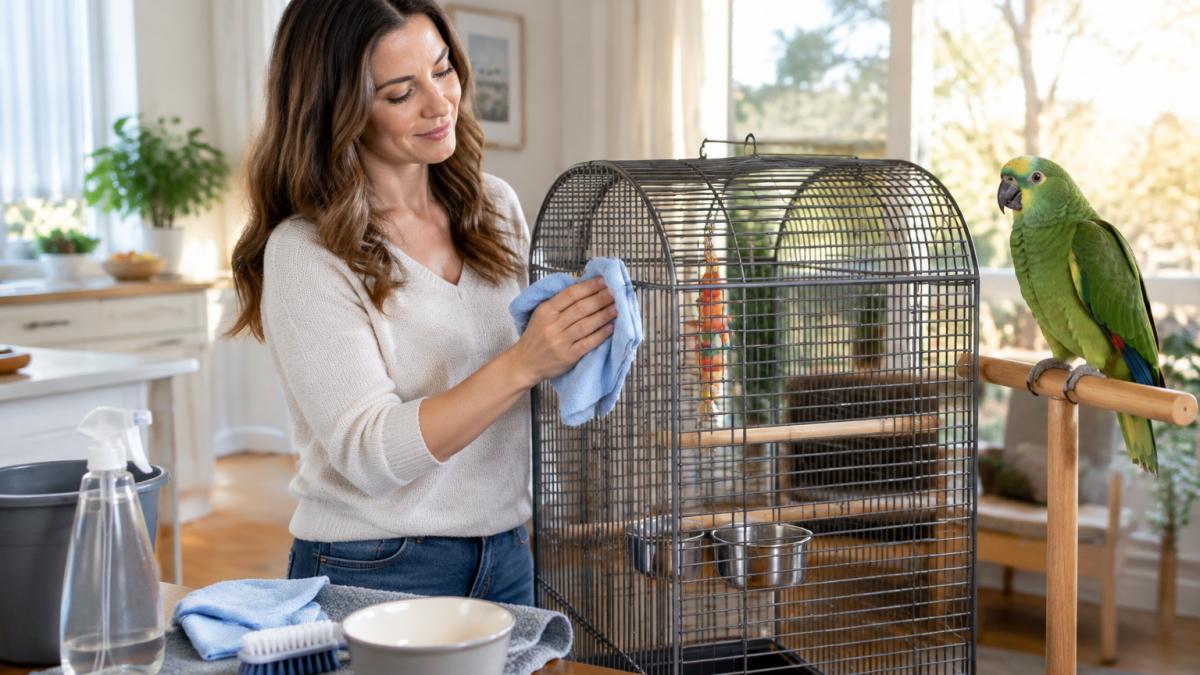
- Prep the room before you touch the cage (2-3 minutes). Close windows to block drafts and street noise, move dogs and cats to another room, and lay every supply within arm's reach. Every trip out of the room mid-clean is a sudden disappearance and return that reads as a threat. Having everything staged means one continuous, predictable session instead of five interrupted ones.
- Announce yourself in a calm, quiet voice (10 seconds). Birds learn auditory cues fast. Saying the same short phrase, "cleaning time", in the same tone before every session turns the clean into a predictable event rather than a surprise. Use a lower volume than your normal speaking voice; sharp or rising tones mimic alarm calls.
- Decide in or out, and commit (1 minute). Spot cleaning, liner swaps, and dish refreshes can happen with the bird in the cage. Anything involving scrubbing, spray, or dismantling perches means moving the bird to a carrier in another quiet room. Make this call before you start so you are not chasing a bird around the cage halfway through.
- Remove toys, perches, and dishes one at a time (3-5 minutes). Take out a single item, replace it with a familiar foraging toy or a favorite perch, then take the next. Stripping the cage bare in one sweep removes every familiar landmark at once and is the single biggest trigger for panic in most companion birds. One-for-one swapping keeps the cage recognizable throughout.
- Clean the liner and tray while your bird is occupied (3-4 minutes). Slide out the tray slowly rather than yanking it, the scrape of a tray on metal is a common startle trigger. Swap in a fresh liner and wipe the tray with a damp cloth. If your bird is watching, narrate softly; a running calm voice masks small noises.
- Scrub grates and bars top to bottom with a soft brush (5-8 minutes). Work from the highest bar downward so debris falls away from clean surfaces instead of onto them. Use the least cleaner that does the job, keep the spray bottle pointed away from the bird, and wipe rather than mist whenever the bird is nearby. Rinse with a plain-water cloth afterward so no residue dries on the bars.
- Put everything back in the same spots (2-3 minutes). Return perches, toys, and dishes to their original positions. Novel placement forces your bird to re-map the cage, which is stressful even when the objects themselves are familiar. Let surfaces air dry fully before the bird returns.
Watch out: Do not combine steps to save time. Removing all perches while scrubbing the tray and spraying bars in one pass is faster for you and far more disruptive for the bird, the whole point of the sequence is that each change is small enough to ignore.
If you also keep reptiles, the same calm, gradual approach applies to habitat work, and our beginner's guide to reptile habitat setup covers the basics.
How to Clean a Bird Cage With the Bird Inside
Whether to clean with your bird in the cage or move them out is the decision that most affects stress on cleaning day, and most guides skip it. Use these criteria rather than guessing.
Keep the bird in the cage when:
- You are spot cleaning droppings, swapping the liner, or refreshing dishes.
- The cleaner is plain water or a diluted vinegar solution applied to a cloth, not sprayed.
- Your bird is calm, perched, and showing none of the stress signals above.
- The session will take under about ten minutes.
Move the bird to a carrier when:
- You are scrubbing grates or bars, dismantling perches, or doing a full breakdown.
- Any spray, disinfectant, or stronger cleaner is involved.
- Your bird is newly adopted, fearful, or noise-sensitive, or is showing stress signals before you start.
- The work will take longer than ten minutes or requires you to reach into the cage repeatedly.
Setting up the carrier so the move itself is low-stress. Use a carrier your bird already associates with calm, one that lives in the room and is used for short, non-vet trips, rather than a carrier that only appears on cleaning day.
Ventilation and fumes. Birds have highly efficient respiratory systems and are sensitive to airborne particles and fumes. Clean in a well-ventilated space, keep windows open in the cleaning room when weather allows, and keep the bird's carrier in a separate room with its own airflow.
For fearful or newly adopted birds, acclimate gradually. Do short, low-stakes sessions first, a liner swap or a dish refresh, so the bird learns that cleaning predicts nothing bad. Over a few weeks, extend the sessions and add tasks.
Bird Cage Cleaning Tools That Make the Job Easier
The right bird cage cleaning tools cut cleaning time and reduce stress for both of you. A few basics cover almost every job:
- Soft bristle brush for grates and bar crevices
- Scrub brush for trays and dishes
- Two spray bottles (cleaner and plain water for rinsing)
- Microfiber cloths for wiping bars
- Spare cage liners so you can swap instead of scrub
- A small carrier for safe relocation
Avoid abrasive pads that scratch cage bars. Scratches trap debris and make future cleaning harder.
How to Clean a Bird Cage With Vinegar
A vinegar solution is one of the safest everyday cleaners for cage surfaces. Mix equal parts white vinegar and water in a spray bottle, wipe surfaces, then rinse thoroughly with clean water.
Vinegar handles light droppings and water stains well. It is not a disinfectant, so for deeper sanitation, follow with a bird-safe cleaner made for cages. Always rinse and let surfaces air dry before returning perches or dishes.
Never mix vinegar with bleach. The combination creates dangerous fumes that harm birds and people.
Bird Cage Cleaner Homemade Recipes That Are Safe
Homemade cleaners work well if you keep them simple and rinse carefully. Here are two simple homemade options:
- Vinegar and water: equal parts white vinegar and clean water. Good for daily wipes.
- Baking soda paste: three parts baking soda to one part water. Use on stuck-on debris, then rinse well.
Skip essential oils, bleach sprays near the cage, and anything with strong scent. Birds have sensitive respiratory systems, and cleaner residue can linger on bars and dishes.
A Practical Cleaning Schedule by Task
A simple schedule keeps cage maintenance predictable, and predictability lowers stress. Here is the routine we recommend:
| Task | Frequency | Time Needed |
|---|---|---|
| Spot clean droppings and swap liner | Daily | 5 minutes |
| Refresh water and food dishes | Daily | 2 minutes |
| Scrub tray, grate, and bars | Weekly | 20 minutes |
| Deep clean perches and toys | Weekly | 15 minutes |
| Full cage breakdown and dry | Monthly | 45 minutes |
Time Needed
Stick to the same days and times. Birds learn routines quickly, and a predictable schedule means fewer surprises.
Stock Up on Bird-Safe Cleaning Supplies at PatriotPetz
Cleaning day gets easier when your supplies are ready before you start. A soft brush, spare liners, and a bird-safe cleaner on hand mean fewer interruptions and a calmer bird.
PatriotPetz is a family-owned pet supply store. Stop by PatriotPetz and we'll help you put together a cleaning kit that fits your bird.
Visit PatriotPetz and make cage cleaning a calm, predictable part of your week.
Cleaning a bird cage doesn't have to stress your bird. With the right tools, a steady schedule, and a gentle approach, you can keep the cage clean and your bird relaxed. Visit PatriotPetz for bird-safe cleaning supplies and expert guidance on caring for your feathered friend.
Frequently Asked Questions
Can I clean a bird cage with the bird still inside?
Yes, for light daily spot cleaning. Swap paper liners, wipe down soiled bars, and refresh food and water dishes while your bird stays put. Keep movements slow and talk softly. For deep cleans that involve scrubbing with water or vinegar solution, move your bird to a secure carrier in another room. That keeps fumes, splashes, and sudden noise away from a bird that is already on edge.
Is vinegar safe to use as a bird cage cleaner?
White vinegar diluted with water is a common bird-safe cleaner for cages. Mix roughly equal parts white vinegar and water in a spray bottle, apply to hard surfaces, and rinse thoroughly with clean water before the cage dries. Never mix vinegar with bleach, since the combination releases dangerous fumes. Let surfaces air dry completely, ideally in the sun, before returning your bird.
How often should I clean a bird cage?
Spot clean daily by removing droppings, changing cage-bottom paper, and washing food and water dishes. Do a full scrub of bars, trays, grates, perches, and toys once a week. Heavy mess from larger birds may need a midweek touch-up. A consistent routine keeps cage hygiene steady and makes each session shorter, which lowers stress for your bird.
How can I calm a stressed bird during cage cleaning?
Move slowly, keep noise low, and avoid sudden movements near the cage. Offer a favorite foraging toy or treat in a carrier during deep cleans so your bird has something to do. Watch for stress signals like panting, feather plucking, or frantic pacing, and pause if they appear. Gradual acclimation helps: short, calm sessions build trust faster than long ones.
